

Chennai-based Endovascular & IR Specialist, Dr. Ravindran Ramalingam offers minimally invasive, scar-free treatments ensuring faster recovery and minimal pain.

Endovascular &
IR Specialist

Center Address
Gleneagles Health City, Perumbakkam, Chennai, TN

Dr. Ravindran Ramalingam is a Chennai-based Endovascular & Interventional Radiology (IR) Specialist with over a decade of experience, delivering minimally invasive, scar-free treatments for faster recovery, less pain, and shorter hospital stays.

Visiting Hours

Thyroid Artery Embolization for Goiter Reduction

A Non-Surgical Option to Reduce Thyroid Swelling

A thyroid goiter can cause visible neck swelling, discomfort, pressure symptoms, and anxiety. Many patients are advised surgery, but not everyone is fit for or comfortable with an operation.

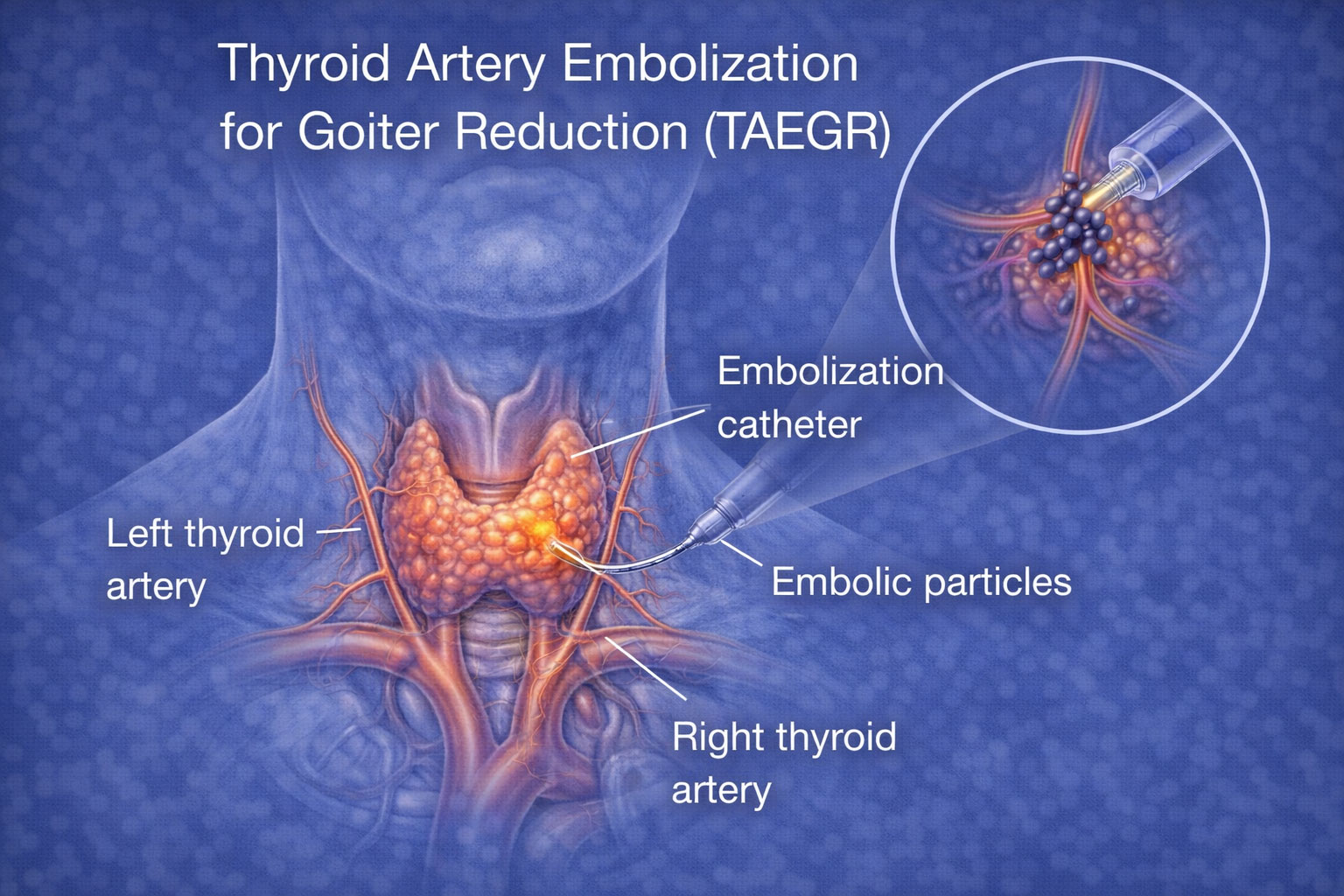
Thyroid Artery Embolization (TAE) is a minimally invasive, non-surgical treatment that reduces goiter size by cutting off its excess blood supply—without removing the thyroid gland.
👉 Concerned about thyroid surgery or scars?

What Is Thyroid Artery Embolization for Goiter Reduction?

Thyroid Artery Embolization (TAE) is an image-guided, minimally invasive procedure used to shrink enlarged thyroid tissue (goiter).

By reducing blood flow to the thyroid:

  • The goiter gradually shrinks
  • Pressure symptoms reduce
  • Neck appearance improves
  • Surgery may be avoided
  • No open surgery
  • No neck scar
  • Thyroid gland preserved
  • Faster recovery

Why Is Thyroid Artery Embolization Done?

TAE may be recommended for:

  • Large goiter causing neck swelling, pressure, or breathing/swallowing difficulty
  • Symptomatic benign thyroid nodules in selected cases
  • Bleeding from the thyroid (for control of hemorrhage)
  • Patients who cannot undergo surgery or want to avoid surgery
  • As a pre-operative measure in some cases to reduce bleeding risk during surgery

Main goals:

  • Reduce thyroid size or blood flow to the problem area
  • Relieve pressure and symptoms
  • Control bleeding
  • Avoid or delay major surgery
  • Improve comfort and quality of life

How Is Thyroid Artery Embolization Done?

The procedure is performed by an interventional radiologist under X-ray guidance.

Step-by-step process:

  • Local anesthesia is given (you stay awake and comfortable)
  • A thin catheter is inserted through a small puncture in the groin or wrist
  • Thyroid arteries supplying the goiter are identified
  • Tiny embolic particles are injected to reduce blood flow
  • The thyroid tissue gradually shrinks over weeks to months
  • Catheter is removed and a small bandage is applied

What Are the Risks?

Thyroid artery embolization is generally safe when performed by experienced specialists. Most side effects are mild and temporary.

Possible risks with approximate incidence include:

  • Neck pain or discomfort – common (20–30%)
  • Low-grade fever or inflammation – common (15–25%)
  • Temporary thyroid hormone imbalance – uncommon (5–10%)
  • Transient voice change – rare (<2%)
  • Skin redness or swelling – uncommon (<5%)
  • Infection – rare (<1%)
  • Non-target embolization – very rare (<1%)

What Are the Alternatives?

Treatment options for thyroid goiter depend on:

  • Your symptoms (neck swelling, pressure, difficulty swallowing or breathing)
  • Size and type of goiter
  • Thyroid hormone levels
  • Overall health and personal preference

Your doctor may recommend one or more of the following options.

Alternative 1: No Active Treatment (Observation Only)

  • Suitable for small, asymptomatic goiters
  • Involves regular clinical and ultrasound follow-up
  • Avoids medications or procedures
  • Limitation: the goiter may continue to grow and cause symptoms over time, potentially delaying effective treatment

Alternative 2: Medications or Radioactive Iodine Therapy

  • Thyroid medicines may help control hormone imbalance, but usually do not significantly reduce goiter size
  • Radioactive iodine therapy may shrink the goiter gradually
  • Avoids surgery, but:
    • Results are slow and variable
    • May lead to hypothyroidism, requiring lifelong medication
    • Not suitable for all patients

Alternative 3: Thyroid Surgery (Thyroidectomy)

  • Partial or complete removal of the thyroid gland
  • Provides definitive size reduction
  • However, surgery:
    • Is more invasive
    • Has higher risks such as voice change, low calcium levels, and scarring
    • Requires longer recovery time
    • Often results in the need for lifelong thyroid hormone replacement

📌 Compared to surgery, embolization avoids scars, preserves the gland, and has quicker recovery.

What Happens After Your Procedure?

Recovery is usually smooth and gradual.

After the procedure:

  • Mild neck discomfort may last a few days
  • Pain medicines are given if required
  • Normal activities resume in 2–3 days
  • Goiter size gradually reduces over weeks to months
  • Pressure and cosmetic symptoms improve
  • Follow-up scans assess volume reduction

Many patients experience significant relief without surgery.

Frequently Asked Questions (FAQs) – Thyroid Artery Embolization for Goiter Reduction

Thyroid artery embolization is a minimally invasive, non-surgical procedure used to reduce the size of an enlarged thyroid (goiter) by blocking excess blood flow to the gland, allowing it to shrink gradually.

This procedure is suitable for patients who:

  • Have large benign goiters
  • Experience pressure, swallowing, or cosmetic problems
  • Are high-risk for surgery or wish to avoid surgery
  • Have recurrent goiter after previous treatment

Yes. When performed by experienced interventional radiologists, TAE is safe and effective, with serious complications being rare.

Most patients experience 30–60% reduction in goiter volume over a few months, along with improvement in pressure and cosmetic symptoms.

No. The thyroid gland is not removed. The procedure reduces blood supply, causing the enlarged tissue to shrink naturally.

Most patients do not require lifelong thyroid hormone therapy, but thyroid function is monitored after the procedure.

Mild to moderate neck discomfort is common for a few days after the procedure and is usually controlled with pain medications.

Recovery is quick. Most patients:

  • Resume normal activities within 2–3 days
  • Experience gradual symptom improvement over weeks

Pressure symptoms may improve within weeks, while goiter size reduction continues over 2–6 months.

Yes. In selected cases, embolization can be safely repeated if further size reduction is needed.

Compared to surgery, embolization:

  • Avoids neck scars
  • Preserves the thyroid gland
  • Has shorter recovery time
  • Is suitable for high-risk surgical patients

Both are effective. Embolization is useful when radioiodine is unsuitable or ineffective, and provides faster volume reduction in some cases.

Yes. TAE is available in specialized centers across India and performed by trained interventional radiologists.

You should consider it if:

  • Goiter size is increasing
  • You have pressure or breathing difficulty
  • You want a non-surgical treatment option

Why Choose Thyroid Artery Embolization?

  • Non-surgical treatment
  • No neck scar
  • Preserves thyroid gland
  • Performed under local anesthesia
  • Faster recovery than surgery
  • Suitable for high-risk surgical patients

Take the Next Step — Without Surgery

If a thyroid goiter is affecting your comfort, breathing, or confidence, you may not need surgery.

Thyroid Artery Embolization offers a modern, minimally invasive alternative.