
Chennai-based Endovascular & IR Specialist, Dr. Ravindran Ramalingam offers minimally invasive, scar-free treatments ensuring faster recovery and minimal pain.

Endovascular &
IR Specialist

Center Address
Gleneagles Health City, Perumbakkam, Chennai, TN

Dr. Ravindran Ramalingam is a Chennai-based Endovascular & Interventional Radiology (IR) Specialist with over a decade of experience, delivering minimally invasive, scar-free treatments for faster recovery, less pain, and shorter hospital stays.

Visiting Hours

Thyroid Nodule Ablation

A Safe, Scar-Free, Minimally Invasive Treatment for Thyroid Nodules

A thyroid nodule is a lump that forms in the thyroid gland in the neck. Most nodules are non-cancerous (benign), but they can still cause neck swelling, discomfort, voice changes, swallowing difficulty, or cosmetic concerns.

Thyroid nodule ablation is a minimally invasive, image-guided treatment that shrinks or destroys the nodule without surgery, helping you avoid scars, stitches, and long recovery time.
👉 Have a thyroid lump and want to avoid surgery?

What Is Thyroid Nodule Ablation?

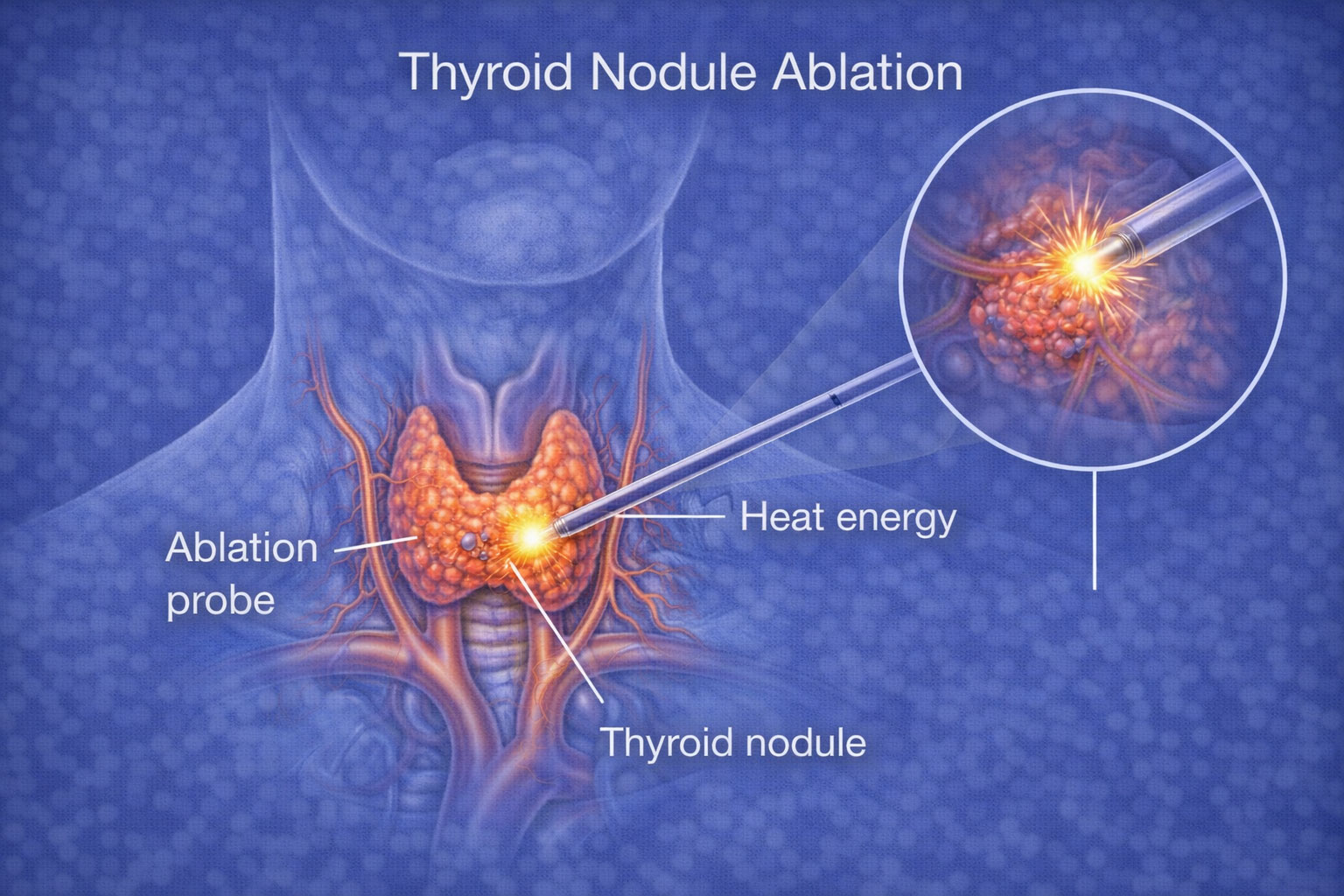
Thyroid nodule ablation is a procedure where a specialist uses:

  • Ultrasound guidance to see the nodule clearly, and
  • Heat or energy (such as radiofrequency, microwave, or laser) to destroy the nodule from inside

Over time, the treated nodule shrinks and symptoms improve.

This treatment:

  • Does not require surgery
  • Does not leave a scar
  • Preserves the normal thyroid gland
  • Allows fast recovery
  • Minimally invasive
  • No stitches or big cuts
  • Day-care procedure in most cases
  • Proven and effective for benign nodules

Why Is Thyroid Nodule Ablation Done?

Thyroid nodule ablation is done when:

  • The nodule is benign (non-cancerous) but causing symptoms
  • You have neck swelling, pressure, or discomfort
  • You have difficulty swallowing or breathing due to the nodule
  • The nodule is visible and causing cosmetic concern
  • The nodule is growing over time
  • You want to avoid surgery or are not fit for surgery
  • In selected cases of overactive (toxic) nodules

Main goals:

  • Reduce the size of the nodule
  • Relieve symptoms
  • Improve appearance and comfort
  • Avoid thyroid surgery and scars

How is Thyroid Nodule Ablation Done?

The procedure is performed by a trained interventional radiologist or specialist using ultrasound guidance.

Step-by-step:

  • You lie comfortably; local anesthesia is given to numb the skin
  • Ultrasound is used to locate the nodule precisely
  • A thin needle-like probe is inserted into the nodule
  • Heat energy (radiofrequency/microwave/laser) is applied to destroy the nodule tissue
  • The probe is moved inside the nodule to treat it completely
  • The probe is removed, and a small bandage is applied

What Are the Risks?

Thyroid nodule ablation is very safe when performed by experienced specialists. However, like any medical procedure, small risks may exist:

  • Mild pain or discomfort at the treatment site
  • Temporary swelling or bruising in the neck
  • Temporary voice change (rare and usually resolves)
  • Mild fever or inflammation
  • Very rare risk of infection
  • Extremely rare risk of damage to surrounding structures

What Are the Treatment Alternatives for Thyroid Nodules?

The best treatment for a thyroid nodule depends on several factors, including:

  • Your symptoms and personal preferences
  • Your overall health condition
  • The size, number, location, and type of thyroid nodules
  • Whether the nodule is benign, hyperactive, or cancerous

In some cases, more than one treatment option may be recommended.

Alternative 1: No Treatment (Active Observation)

  • If the thyroid nodule is benign (non-cancerous)
  • If it is small and not causing symptoms
  • If there is no difficulty in swallowing, breathing, or cosmetic concern

In such cases, treatment may not be needed immediately. Regular ultrasound follow-up and clinical monitoring may be enough.

Alternative 2: Thyroid Surgery

  • Involves removing part or all of the thyroid gland
  • Often the preferred treatment for thyroid cancer
  • May be recommended for very large nodules or suspicious nodules

However, thyroid surgery:

  • Is a major operation
  • Has a longer recovery period
  • Carries higher risks such as voice change, low calcium levels, and need for lifelong thyroid medication

Alternative 3: Radioactive Iodine (Radiation Therapy)

  • Commonly used for hyperactive (overactive) thyroid nodules
  • Given as a radioactive iodine pill
  • The hyperactive nodule absorbs most of the radiation
  • Radiation gradually reduces or destroys the nodule

This treatment may also be used in thyroid cancer patients after surgery in selected cases.

Choosing the Right Thyroid Nodule Treatment

Each thyroid nodule is different. A detailed evaluation by an expert interventional radiologist is essential to decide the safest and most effective treatment option—whether it is observation, surgery, radiation, or a minimally invasive thyroid ablation procedure.

📌 Compared to surgery, ablation offers faster recovery, no scars, and preservation of thyroid function.

What Happens After Thyroid Nodule Ablation?

Recovery is quick and smooth for most patients.

After the procedure:

  • You can usually go home the same day
  • Mild soreness may last 1–2 days
  • Normal activities can be resumed within 24–48 hours
  • No stitches or dressing removal needed
  • Nodule gradually shrinks over weeks to months
  • Follow-up ultrasound is done to monitor size reduction

Most patients notice significant symptom relief and cosmetic improvement

Frequently Asked Questions (FAQs) – Thyroid Nodule Ablation

Thyroid nodule ablation is a minimally invasive, non-surgical treatment that uses heat energy (radiofrequency, microwave, or laser) to shrink or destroy a thyroid nodule without removing the thyroid gland.

It is suitable for patients who have benign (non-cancerous) thyroid nodules that cause neck swelling, pressure, swallowing difficulty, voice discomfort, or cosmetic concerns, or nodules that keep growing.

No. It is a needle-based, image-guided procedure, not open surgery, and it does not leave a scar.

It is done under local anesthesia, so most patients feel only mild discomfort or heat sensation during the procedure.

The procedure usually takes 30 to 60 minutes, depending on the size of the nodule.

No. Most patients are discharged the same day after a short observation period.

Most treated nodules shrink by 50–90% over time, and symptoms like pressure or visible swelling improve significantly.

The nodule usually shrinks gradually over months. It may not disappear completely, but it becomes much smaller and symptom-free.

The treated part usually does not grow back, but new nodules can sometimes develop in other parts of the thyroid.

In most cases, no. The normal thyroid gland is preserved, so thyroid function usually remains normal.

Possible risks include mild pain or swelling, bruising, temporary voice change, bleeding, or infection. Serious complications are rare.

Most patients return to normal activities within 1–2 days.

Ablation is non-surgical, scar-free, done under local anesthesia, and has faster recovery, while surgery involves cuts, stitches, and longer hospital stay.

Yes. It is a well-established and safe procedure when done by experienced specialists.

Yes. It is available in advanced hospitals and interventional radiology/endocrine centers across India.

Why Choose Thyroid Nodule Ablation?

Take the Next Step — Without Surgery

If your thyroid nodule is causing discomfort, pressure, or cosmetic concerns, you don’t always need surgery.

Thyroid nodule ablation offers a safe, scar-free, and effective solution.
Smaller nodule. More comfort. No surgery.