

Chennai-based Endovascular & IR Specialist, Dr. Ravindran Ramalingam offers minimally invasive, scar-free treatments ensuring faster recovery and minimal pain.

Endovascular &
IR Specialist

Center Address
Gleneagles Health City, Perumbakkam, Chennai, TN

Dr. Ravindran Ramalingam is a Chennai-based Endovascular & Interventional Radiology (IR) Specialist with over a decade of experience, delivering minimally invasive, scar-free treatments for faster recovery, less pain, and shorter hospital stays.

Visiting Hours

Varicose Veins

Varicose Vein Ablation, VenaSeal, MOCA & Foam Sclerotherapy

Modern, Non-Surgical Treatments for Varicose Veins

Varicose veins are not just a cosmetic issue. They can cause pain, swelling, skin changes, and long-term complications if left untreated. Today, advanced minimally invasive treatments like Varicose Vein Ablation, VenaSeal, MOCA, and Foam Sclerotherapy allow effective treatment without surgery, stitches, or long hospital stays.
👉 Tired of leg pain, swelling, or visible veins?

What Is Varicose Vein Ablation?

Varicose vein ablation is a minimally invasive, image-guided procedure used to close faulty veins that cause varicose veins.

By sealing the abnormal vein:

  • Blood is redirected to healthy veins
  • Pressure reduces
  • Pain and swelling improve
  • Visible veins gradually disappear
  • No open surgery

  • No stitches or scars

  • Day-care procedure

  • Fast recovery

What Are Varicose Veins?

Varicose veins are enlarged, twisted veins that usually appear in the legs due to weak or damaged vein valves.

Common symptoms include:

  • Aching or heavy legs
  • Swelling of feet or ankles
  • Burning or itching sensation
  • Night cramps
  • Skin darkening or ulcers (in advanced cases)

Standing for long hours, pregnancy, obesity, and family history increase the risk.

How Are Varicose Vein Ablation, VenaSeal, MOCA & Foam Sclerotherapy Done?

These treatments are performed by an interventional radiologist under ultrasound guidance. The choice depends on vein size, anatomy, and symptoms.

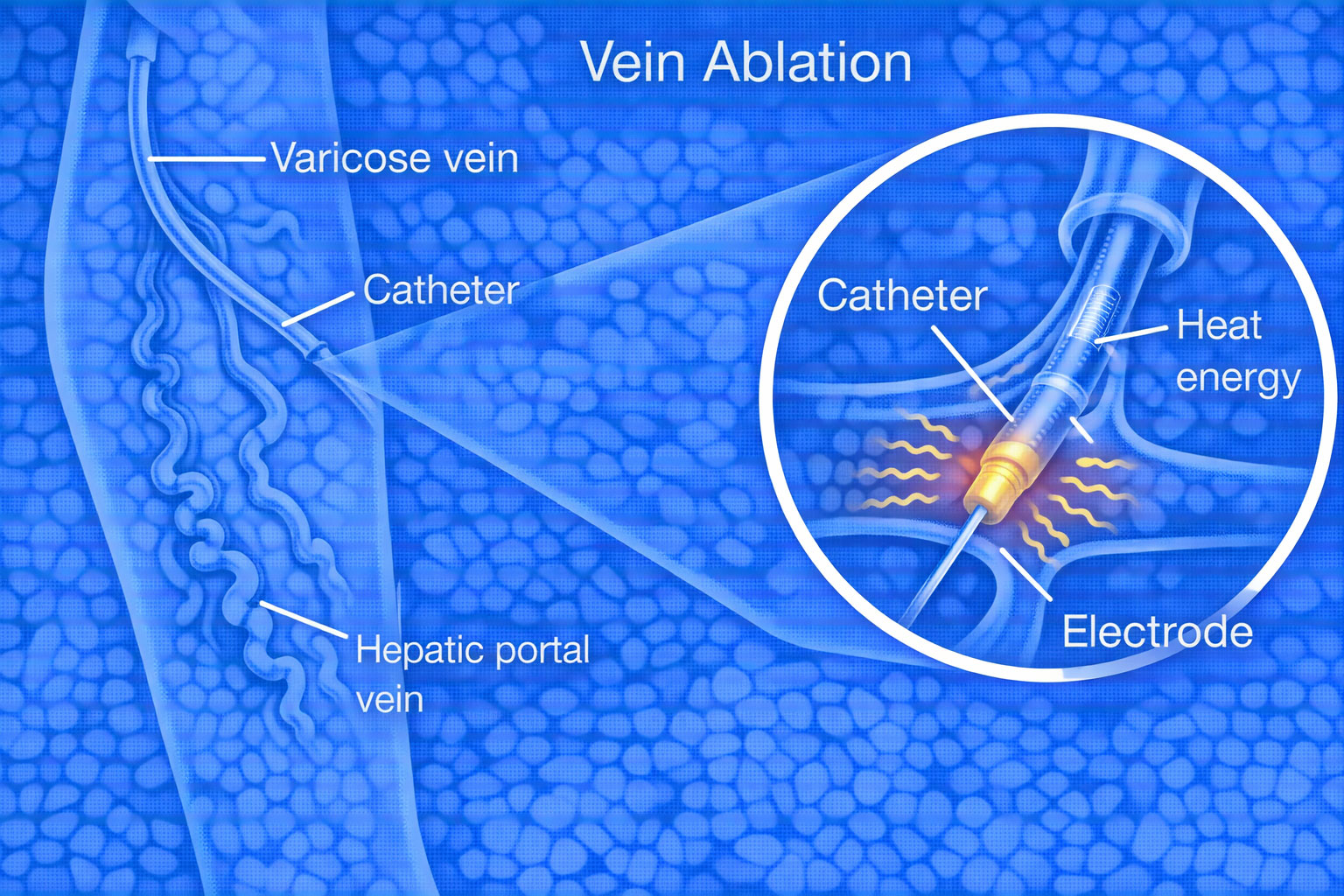
🔹 Varicose Vein Ablation (Laser / Radiofrequency / Microwave)

  • Local anesthesia is given
  • A thin catheter is inserted into the vein
  • Heat energy seals the faulty vein from inside
  • The vein closes and disappears over time

🔹 VenaSeal (Glue Closure)

  • No heat and usually no anesthesia
  • Medical glue is injected into the vein
  • The vein seals instantly
  • No compression stockings needed in most cases

🔹 MOCA (Mechanochemical Ablation)

  • Combines mechanical irritation + medication
  • No heat, no injections around the vein
  • Minimal pain and faster recovery

🔹 Foam Sclerotherapy

  • Special foam medicine is injected into veins
  • Veins collapse and are absorbed by the body
  • Ideal for smaller veins and residual varicosities

What Are the Risks?

These procedures are very safe when done by experienced specialists. Possible risks with approximate incidence include:

  • Mild pain or tightness – common (20–30%)
  • Bruising or swelling – common (15–25%)
  • Skin discoloration – uncommon (5–10%)
  • Superficial vein inflammation – uncommon (5–8%)
  • Allergic reaction (VenaSeal) – rare (<2%)
  • Deep vein thrombosis (DVT) – very rare (<1%)
  • Infection – extremely rare (<1%)

What Are the Alternatives?

Treatment choices for varicose veins depend on:

  • Your symptoms and discomfort
  • Overall health and daily activity level
  • Personal preferences and vein condition

Your doctor may recommend one or more of the following options.

Alternative 1: Compression Stockings

  • Special medical stockings that gently squeeze the legs
  • Help collapse superficial veins and improve blood flow
  • Reduce leg swelling, heaviness, and aching
  • Commonly used as the first-line treatment for varicose veins
  • Do not remove the vein but help control symptoms

Alternative 2: Vein Stripping Surgery

  • A surgical procedure to remove the abnormal vein
  • Requires cuts in the leg and anesthesia
  • Considered more invasive than non-surgical vein treatments
  • Involves a longer recovery period and higher discomfort compared to minimally invasive options

Choosing the Right Varicose Vein Treatment

While compression stockings and surgery are traditional options, many patients today benefit from minimally invasive, image-guided vein treatments that offer faster recovery, less pain, and no major scars

📌 Compared to surgery, modern vein treatments are safer, scar-free, and allow faster recovery.

What Happens After Your Procedure?

Recovery is quick and comfortable for most patients.

After treatment:

  • Walking is encouraged the same day
  • Mild soreness may last a few days
  • Normal activities resume in 1–3 days
  • Compression stockings may be advised (except VenaSeal)
  • Visible veins fade gradually over weeks
  • Leg pain, swelling, and heaviness improve significantly

Frequently Asked Questions (FAQs) – Varicose Vein Ablation, VenaSeal, MOCA & Foam Sclerotherapy

Modern non-surgical treatments include laser or radiofrequency ablation, VenaSeal (glue closure), MOCA (mechanochemical ablation), and foam sclerotherapy. These close faulty veins without surgery or stitches.

The best treatment depends on vein size, location, and severity. An ultrasound scan helps the doctor choose the most suitable option among ablation, VenaSeal, MOCA, or foam sclerotherapy.

Yes. Varicose vein ablation is a safe and well-established procedure with a high success rate when performed by an experienced specialist.

VenaSeal uses a medical glue to seal the vein. It does not use heat, usually needs no anesthesia, and often does not require compression stockings after the procedure.

MOCA (mechanochemical ablation) combines mechanical vein irritation and medication to close the vein. It is usually less painful and does not use heat.

Foam sclerotherapy is commonly used for smaller varicose veins, spider veins, or leftover veins after ablation. A special foam medicine is injected to close the vein.

Most patients experience minimal pain or discomfort. Procedures are done under local anesthesia and are well tolerated.

Recovery is fast. Most patients:

  • Walk the same day
  • Resume normal activities within 1–3 days
  • Avoid strenuous exercise for about a week

No. These treatments are usually day-care procedures, and patients go home the same day.

Treated veins usually do not return. However, new varicose veins may develop over time, which can be treated easily with the same methods.

Compression stockings are often advised after ablation, MOCA, or foam sclerotherapy. After VenaSeal, stockings may not be required in many cases.

Yes. These minimally invasive treatments are especially suitable for elderly patients and those with medical conditions, as they avoid major surgery.

Yes. PAE is available in specialized centers across India and is performed by trained interventional radiologists using advanced imaging techniques.

You should consider PAE if:

  • Prostate medicines are not helping
  • You want to avoid surgery
  • Urinary symptoms are affecting your sleep or quality of life

A detailed consultation, prostate imaging, and urology evaluation help determine whether PAE is the right treatment option for you.

Why Choose Prostate Artery Embolization?

  • Non-surgical treatment

  • No prostate removal

  • No scars or stitches

  • Performed under local anesthesia

  • Short hospital stay

  • Faster recovery than surgery

  • Preserves sexual function in most patients

Take the Next Step — Without Surgery

If prostate symptoms are affecting your sleep, comfort, or daily life, you don’t have to rush into surgery.

Prostate Artery Embolization offers a modern, minimally invasive alternative.