

Chennai-based Endovascular & IR Specialist, Dr. Ravindran Ramalingam offers minimally invasive, scar-free treatments ensuring faster recovery and minimal pain.

Endovascular &
IR Specialist

Center Address
Gleneagles Health City, Perumbakkam, Chennai, TN

Dr. Ravindran Ramalingam is a Chennai-based Endovascular & Interventional Radiology (IR) Specialist with over a decade of experience, delivering minimally invasive, scar-free treatments for faster recovery, less pain, and shorter hospital stays.

Visiting Hours

Prostate Artery Embolization

A Non-Surgical Treatment for Enlarged Prostate (BPH)

An enlarged prostate is a common problem in aging men and can significantly affect quality of life. Prostate Artery Embolization (PAE) is a modern, minimally invasive, non-surgical treatment that reduces prostate size and improves urinary symptoms without surgery or prostate removal.
👉 Troubled by frequent urination or weak urine flow?

What Is Prostate Artery Embolization?

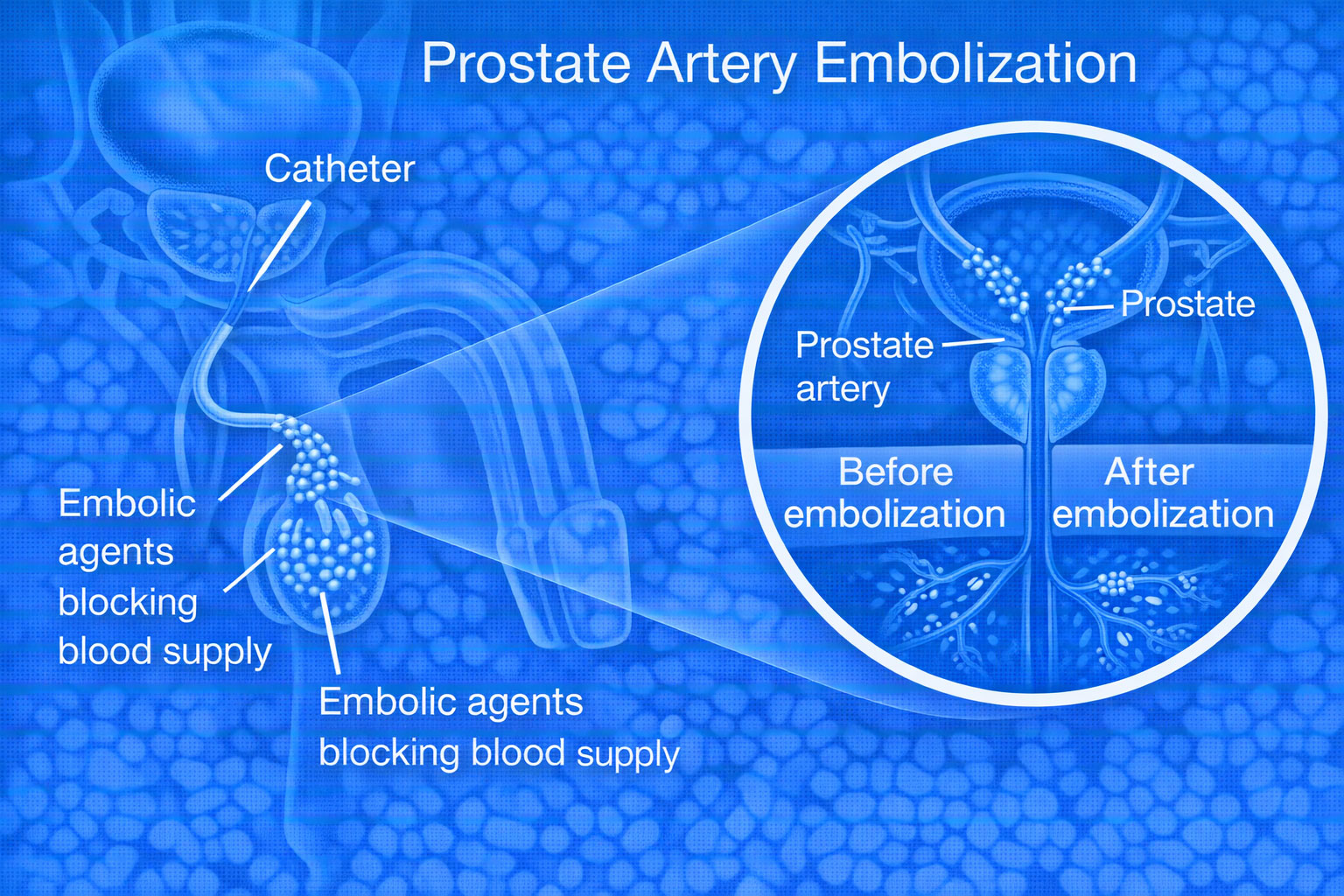
Prostate Artery Embolization (PAE) is a non-surgical, image-guided procedure used to treat symptoms of an enlarged prostate.

In this procedure:

  • Blood supply to the prostate is reduced
  • The prostate gradually shrinks
  • Pressure on the urinary passage decreases
  • Urinary symptoms improve over time
  • No surgery

  • No cutting or stitches

  • No prostate removal

  • Preserves sexual function in most patients

Why Is Prostate Artery Embolization Done?

PAE is done for men who have moderate to severe urinary symptoms due to BPH, such as:

  • Weak urine stream
  • Frequent urination, especially at night
  • Urgency to pass urine
  • Difficulty starting or stopping urine
  • Feeling that the bladder is not empty
  • Poor response or side effects from medicines
  • High risk for surgery or wish to avoid surgery

Main goals:

  • Reduce prostate size
  • Improve urine flow and bladder emptying
  • Reduce night-time urination
  • Avoid or delay prostate surgery
  • Improve quality of life

How Is Prostate Artery Embolization Done?

PAE is performed by an interventional radiologist using advanced imaging guidance.

Step-by-step process:

  • Local anesthesia is given (you remain awake and comfortable)
  • A thin catheter is inserted through a small puncture in the groin or wrist
  • Prostate arteries are identified using live X-ray imaging
  • Tiny particles are injected to block blood flow to the prostate
  • The prostate slowly shrinks over weeks to months
  • Catheter is removed and a small bandage is applied

What Are the Risks?

Prostate artery embolization is generally very safe when performed by experienced specialists. Most side effects are mild and temporary.

Possible risks include:

  • Mild pelvic pain or discomfort – common (20–30%)
  • Burning during urination (dysuria) – common (20–25%)
  • Temporary increase in urinary symptoms – common (10–20%)
  • Blood in urine, semen, or stool – uncommon (5–10%)
  • Urinary infection – uncommon (<5%)
  • Temporary urinary retention – rare (<5%)
  • Non-target embolization (serious complication) – very rare (<1%)

What Are the Alternatives?

Treatment options for an enlarged prostate depend on:

  • Your symptoms and quality of life
  • Overall health and existing medical conditions
  • Personal preferences and long-term goals

Your doctor will help decide the most suitable option for you.

Alternative 1: Supplements for Enlarged Prostate

  • Natural supplements such as saw palmetto, beta-sitosterol, cernilton, and Pygeum africanum
  • Considered non-invasive and easy to take
  • Scientific evidence is limited, and results vary
  • Generally less effective in relieving moderate to severe urinary symptoms

Alternative 2: Medications for BPH

  • Often the first-line treatment for prostate enlargement
  • Can improve urinary symptoms in some patients
  • Helps avoid an immediate procedure or surgery
  • May need long-term use, and effectiveness can reduce over time
  • Some patients may continue to have symptoms despite medication

Alternative 3: Surgery for Enlarged Prostate

  • Includes procedures such as:
    • TURP (Transurethral Resection of the Prostate) – shaving excess prostate tissue
    • Prostatectomy – partial or complete removal of the prostate
    • Laser Prostate Surgery – Laser energy is used to remove or vaporize enlarged prostate tissue.
  • These options offer the most durable long-term symptom relief
  • Lower chance of symptoms returning
  • However, they:
    • Carry a higher risk of complications (up to 1 in 5 patients)
    • Have longer recovery times compared to minimally invasive options like Prostate Artery Embolization (PAE)

Choosing the Right BPH Treatment

Each patient’s condition is different. A detailed evaluation helps balance symptom relief, risks, recovery time, and long-term outcomes to choose the best treatment for enlarged prostate.

📌 Compared to surgery, PAE offers fewer complications, no sexual side effects in most patients, and faster recovery.

What Happens After Your Procedure?

Recovery after PAE is usually smooth.

After the procedure:

  • Mild pelvic discomfort or burning may last a few days
  • Pain medications are prescribed
  • Most patients walk within a few hours
  • Normal daily activities resume in 2–3 days
  • Urinary symptoms gradually improve over 4–12 weeks
  • Prostate size reduces over months
  • Sexual function is usually preserved

Frequently Asked Questions (FAQs) – Prostate Artery Embolization

Prostate artery embolization (PAE) is a non-surgical, minimally invasive treatment for enlarged prostate (BPH). It works by reducing blood flow to the prostate, causing it to shrink and improving urinary symptoms.

Yes. PAE is a safe and well-established procedure when performed by an experienced interventional radiologist. Major complications are rare.

PAE is suitable for men who:

  • Have moderate to severe urinary symptoms
  • Have large prostate size
  • Do not respond well to medications
  • Want to avoid prostate surgery
  • Are at high surgical risk due to age or medical conditions

Studies show that 75–85% of patients experience significant improvement in urinary symptoms such as frequent urination, weak stream, and night-time urination after PAE.

Most patients notice symptom improvement within 2–4 weeks, with continued improvement over 2–3 months as the prostate gradually shrinks.

In most patients, erection and ejaculation are preserved. Unlike some surgical treatments, PAE has a low risk of sexual side effects.

The procedure itself is usually painless due to local anesthesia. Mild pelvic discomfort or burning during urination may occur for a few days and is easily controlled with medications

Recovery is quick. Most patients:

  • Go home the same day or next day
  • Resume normal activities within 2–3 days
  • Avoid heavy exercise for about a week

PAE is a good alternative for selected patients because it is:

  • Non-surgical
  • Scar-free
  • Done under local anesthesia
  • Associated with fewer sexual side effects
    However, the best treatment depends on individual evaluation.

Yes. If symptoms return or improvement is incomplete, PAE can be safely repeated in selected cases.

Most patients do not require long-term catheterization. Some may need a temporary catheter for a short duration if urinary retention occurs.

PAE provides long-lasting symptom relief for most patients. Long-term studies show sustained improvement in many men.

Yes. PAE is available in specialized centers across India and is performed by trained interventional radiologists using advanced imaging techniques.

You should consider PAE if:

  • Prostate medicines are not helping
  • You want to avoid surgery
  • Urinary symptoms are affecting your sleep or quality of life

A detailed consultation, prostate imaging, and urology evaluation help determine whether PAE is the right treatment option for you.

Why Choose Prostate Artery Embolization?

  • Non-surgical treatment

  • No prostate removal

  • No scars or stitches

  • Performed under local anesthesia

  • Short hospital stay

  • Faster recovery than surgery

  • Preserves sexual function in most patients

Take the Next Step — Without Surgery

If prostate symptoms are affecting your sleep, comfort, or daily life, you don’t have to rush into surgery.

Prostate Artery Embolization offers a modern, minimally invasive alternative.