

Chennai-based Endovascular & IR Specialist, Dr. Ravindran Ramalingam offers minimally invasive, scar-free treatments ensuring faster recovery and minimal pain.

Endovascular &
IR Specialist

Center Address
Gleneagles Health City, Perumbakkam, Chennai, TN

Dr. Ravindran Ramalingam is a Chennai-based Endovascular & Interventional Radiology (IR) Specialist with over a decade of experience, delivering minimally invasive, scar-free treatments for faster recovery, less pain, and shorter hospital stays.

Visiting Hours

Gonadal Vein Embolization for Chronic Pelvic Pain

A Non-Surgical, Effective Treatment for Pelvic Congestion Syndrome

Chronic pelvic pain can be frustrating, exhausting, and often misunderstood—especially when routine tests come back “normal.” In many women, the cause is Pelvic Congestion Syndrome (PCS).

Gonadal vein embolization is a minimally invasive, non-surgical treatment that targets the root cause of pain and provides long-lasting relief—without surgery or scars.
👉 Living with unexplained pelvic pain for months or years?

What Is Gonadal Vein Embolization?

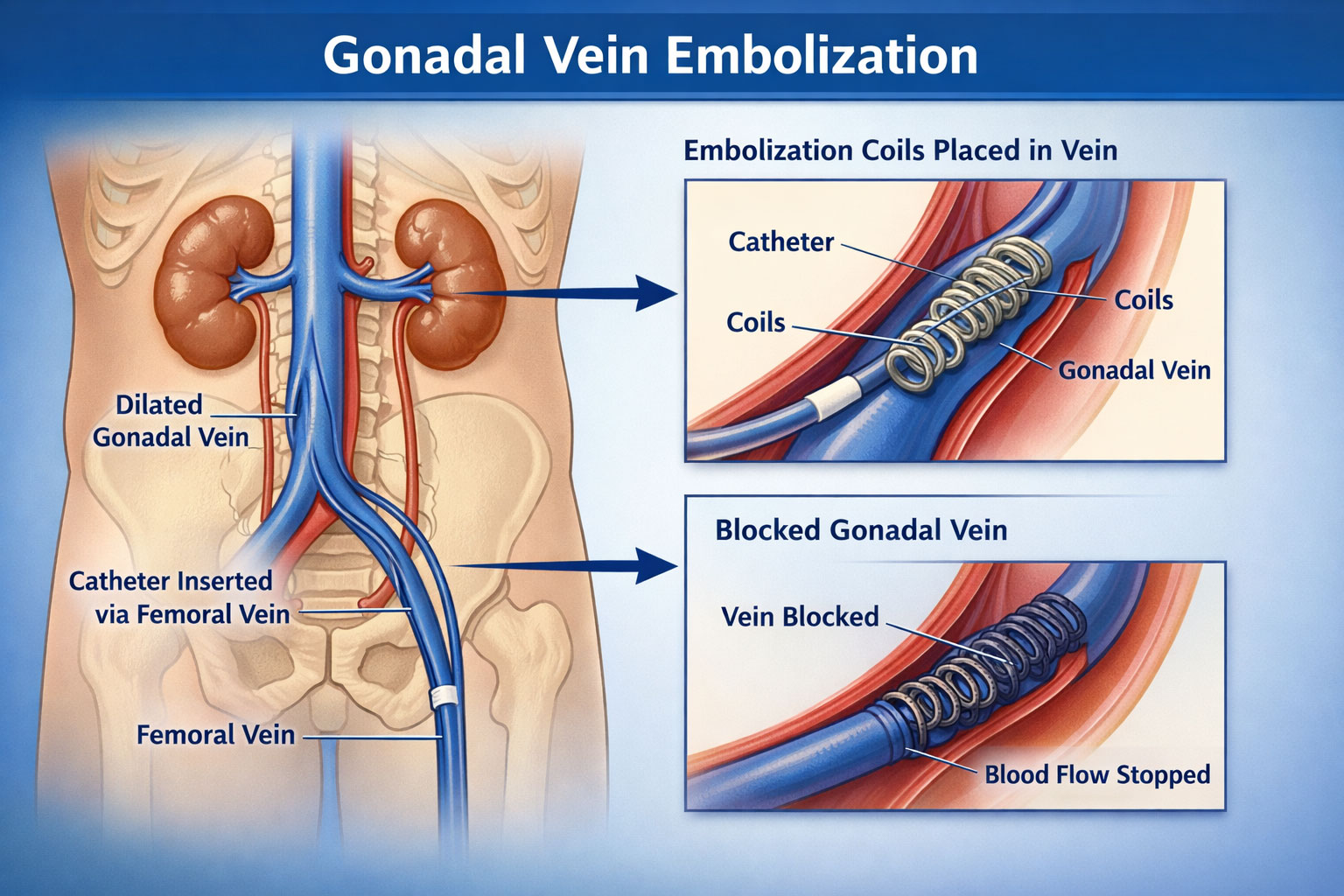
Gonadal vein embolization is an image-guided procedure used to treat chronic pelvic pain caused by abnormal, dilated pelvic veins.

The treatment works by:

  • Closing faulty ovarian (gonadal) veins
  • Redirecting blood to healthy veins
  • Reducing venous pressure and congestion
  • Relieving chronic pelvic pain
  • No open surgery

  • No stitches or scars

  • Day-care procedure

  • Uterus and ovaries preserved

Why Is Gonadal Vein Embolization Done?

This procedure is mainly done for women with Pelvic Congestion Syndrome (PCS) who have:

  • Chronic pelvic pain lasting more than 6 months
  • Pain that is worse after standing, at the end of the day, or after pregnancy
  • Heaviness or aching in the lower abdomen or pelvis
  • Pain during or after sexual intercourse
  • Visible varicose veins around the pelvis, vulva, or thighs (in some cases)
  • Poor response to pain medicines or hormonal treatments

Main goals:

  • Relieve chronic pelvic pain
  • Reduce pelvic vein pressure and congestion
  • Avoid major surgery

Improve daily activity, comfort, and quality of life

How Is Gonadal Vein Embolization Done?

The procedure is performed by an interventional radiologist under X-ray (fluoroscopy) guidance.

Step-by-step procedure:

  • Local anesthesia is given (you stay awake and comfortable)
  • A thin catheter is inserted through a small puncture in the neck or groin
  • The gonadal (ovarian) veins are identified
  • Coils or medical agents are placed to close abnormal veins
  • Blood flow is redirected to healthy veins
  • The catheter is removed and a small bandage is applied

What Are the Risks?

Gonadal vein embolization is very safe when performed by experienced specialists.
Most side effects are mild and temporary.

Possible risks with approximate incidence include:

  • Mild pelvic pain or cramping – common (20–30%)
  • Low-grade fever or nausea – common (10–15%)
  • Bruising at puncture site – common (10–15%)
  • Allergic reaction to contrast dye – rare (<2%)
  • Infection – very rare (<1%)
  • Vein perforation or coil migration – extremely rare (<1%)

What Are the Alternatives?

Treatment choices depend on:

  • Severity of chronic pelvic pain and related symptoms
  • Overall health and daily activity level
  • Personal preferences and long-term goals

Your clinician will help you select the most appropriate option.

Alternative 1:

No Active Treatment (Observation)

  • Avoids procedures or surgery
  • However, abnormal pelvic veins and chronic pelvic pain usually do not improve on their own
  • Symptoms may persist or worsen over time
  • Ongoing pain can affect quality of life and daily activities

Alternative 2: Surgical Treatment for Pelvic Varicose Veins

  • Involves tying off or removing the enlarged pelvic veins through surgery
  • May have a slightly lower chance of vein recurrence
  • However, surgery:
    • Is more invasive
    • Carries a higher risk of complications
    • Requires longer recovery time and hospital stay compared to minimally invasive options

Choosing the Right Pelvic Pain Treatment

While observation and surgery are options, many patients benefit from minimally invasive, image-guided treatments that target abnormal pelvic veins with less pain, fewer risks, and faster recovery.

📌 Compared to surgery, embolization is safer, uterus-preserving, and has faster recovery.

What Happens After Your Procedure?

Recovery is usually quick and smooth.

After embolization:

  • Mild pelvic discomfort may last a few days
  • Pain medicines are given if needed
  • Normal activities resume in 2–3 days
  • Pelvic pain gradually improves over 2–6 weeks
  • Long-term pain relief is common

Most women report significant improvement in quality of life.

Frequently Asked Questions (FAQs) – Gonadal Vein Embolization for Chronic Pelvic Pain

Gonadal vein embolization is a minimally invasive, non-surgical procedure used to treat chronic pelvic pain caused by Pelvic Congestion Syndrome (PCS) by closing abnormal pelvic veins.

Pelvic congestion syndrome is a condition caused by dilated, leaky pelvic veins, similar to varicose veins in the legs, leading to long-standing pelvic pain in women.

Women who have:

  • Chronic pelvic pain lasting more than 6 months
  • Pain worse on standing or after intercourse
  • Multiple pregnancies
  • Poor response to pain medicines
    may benefit from this treatment.

Yes. When performed by experienced interventional radiologists, gonadal vein embolization is safe and well established, with serious complications being rare.

Studies show 70–90% of patients experience significant or complete relief from chronic pelvic pain after embolization.

The procedure itself is painless as it is done under local anesthesia. Mild pelvic discomfort afterward is common but temporary.

The procedure usually takes 45–90 minutes and is performed as a day-care treatment.

Some patients notice improvement within a few days, while most experience significant relief over 2–6 weeks.

No. The uterus and ovaries are preserved, and fertility is not affected by this procedure.

No. Most patients go home the same day after the procedure.

Recurrence is uncommon. If pain returns, embolization can be safely repeated in selected cases.

Compared to surgery, embolization:

  • Is non-surgical
  • Has no scars
  • Preserves reproductive organs
  • Has faster recovery and fewer complications

Risks are usually mild and temporary, such as pelvic discomfort or low-grade fever. Serious complications are very rare (<1%).

Yes. It is available in specialized interventional radiology centers across India.

You should seek evaluation if:

  • Pelvic pain lasts more than 6 months
  • Pain worsens after standing or during intercourse
  • Routine tests are normal but pain persists

Why Choose Gonadal Vein Embolization?

  • Non-surgical treatment

  • No scars or stitches

  • Preserves uterus and ovaries

  • Faster recovery than surgery

  • Effective long-term pain relief

  • Treats the root cause of pain

Take the Next Step Toward Pain-Free Living

If chronic pelvic pain is affecting your comfort, relationships, or daily life, you don’t have to live with it.

Gonadal Vein Embolization offers a safe, minimally invasive, and effective solution.