

Chennai-based Endovascular & IR Specialist, Dr. Ravindran Ramalingam offers minimally invasive, scar-free treatments ensuring faster recovery and minimal pain.

Endovascular &
IR Specialist

Center Address
Gleneagles Health City, Perumbakkam, Chennai, TN

Dr. Ravindran Ramalingam is a Chennai-based Endovascular & Interventional Radiology (IR) Specialist with over a decade of experience, delivering minimally invasive, scar-free treatments for faster recovery, less pain, and shorter hospital stays.

Visiting Hours

Vertebral Augmentation for Back Pain

A Minimally Invasive Treatment for Painful Spine Fractures

Sudden or persistent back pain—especially after a minor fall or in older adults—may be due to a spinal (vertebral) compression fracture.

Vertebral augmentation is a minimally invasive procedure that stabilizes the fractured bone, reduces pain, and helps patients return to daily activities without major spine surgery.
👉 Severe back pain after a fall or osteoporosis?

What Is Vertebral Augmentation?

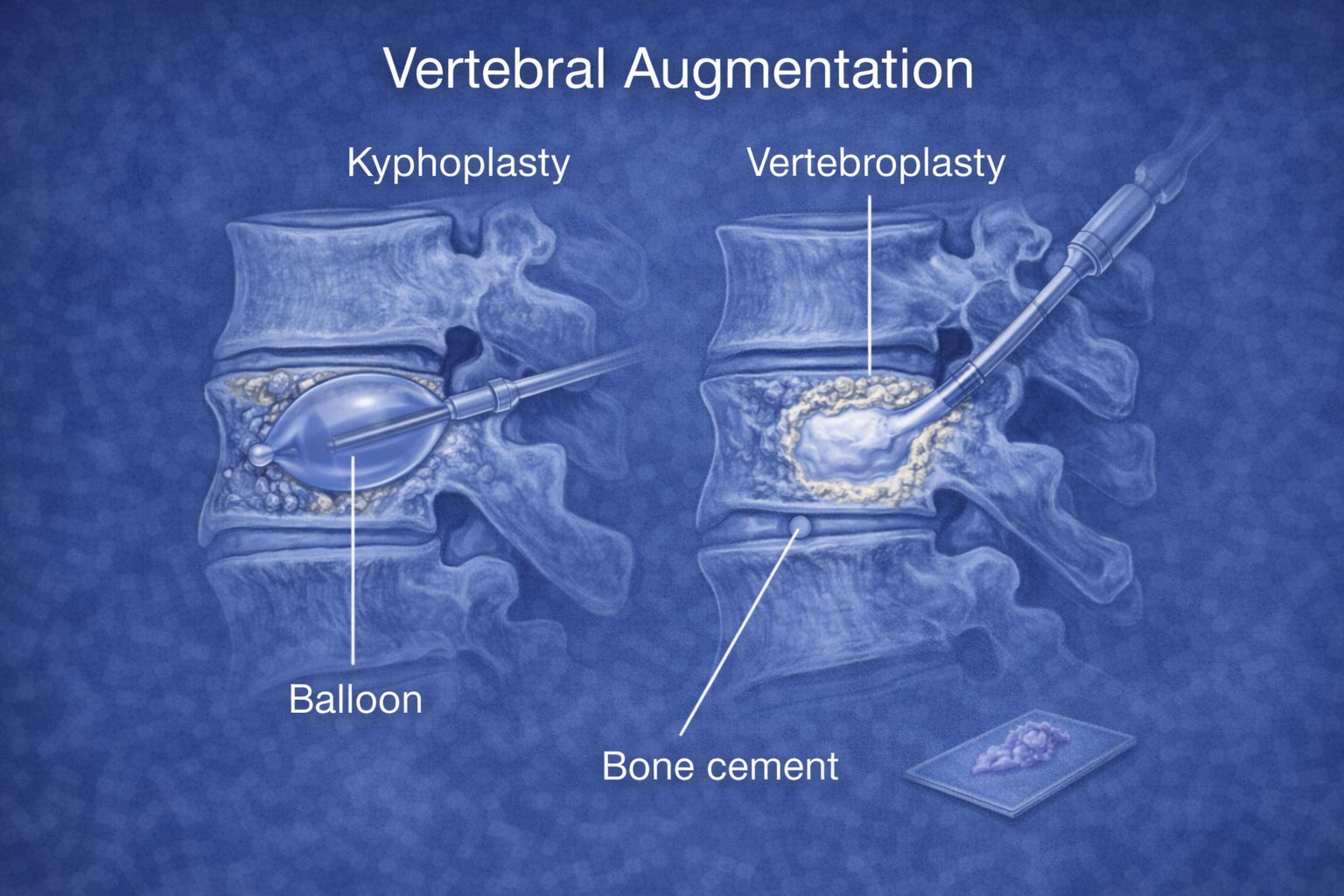
Vertebral augmentation is a non-surgical, image-guided treatment used to stabilize a fractured vertebra (spinal bone) by injecting medical bone cement into it.

Common types include:

  • Vertebroplasty
  • Kyphoplasty (uses a small balloon to restore height before cement)

This treatment helps by:

  • Stabilizing the broken bone
  • Reducing pain quickly
  • Improving mobility and posture
  • Preventing further collapse
  • No open surgery

  • Small needle entry

  • Day-care procedure

  • Fast pain relief

Why Is Vertebral Augmentation Done?

Vertebral augmentation is done for painful vertebral compression fractures that do not improve with rest or medicines.

Common causes include:

  • Osteoporosis (most common)
  • Minor falls or trauma
  • Cancer-related spine weakness
  • Long-term steroid use

Symptoms may include:

  • Sudden severe back pain
  • Pain worsened by standing or walking
  • Reduced height or stooped posture
  • Difficulty with daily activities

How Is Vertebral Augmentation Done?

The procedure is performed by a trained specialist using X-ray or CT guidance.

Step-by-step procedure:

  • You lie comfortably on the procedure table
  • Local anesthesia and light sedation are given
  • A thin needle is guided into the fractured vertebra
  • (Kyphoplasty) A small balloon may be inflated to restore height
  • Medical bone cement is injected to stabilize the bone
  • The needle is removed and a small dressing is applied

What Are the Risks?

Vertebral augmentation is generally very safe when done by experienced specialists.
Possible risks with approximate incidence include:

  • Temporary increase in back pain – common (10–20%)
  • Cement leakage (usually without symptoms) – uncommon (5–10%)
  • Bruising or soreness at needle site – common (10–15%)
  • Infection – rare (<1%)
  • Nerve irritation or weakness – very rare (<1%)
  • Blood clot or lung complication – extremely rare (<0.5%)

What Are the Alternatives?

Treatment options depend on:

  • Your pain severity and mobility
  • The cause of the fracture (osteoporosis, trauma, or tumor)
  • Overall health and personal preferences

Your clinician will help you choose the most appropriate option.

Alternative 1: Conservative Treatment (Medicines and Back Brace)

  • Pain-relieving medicines may be used to control back pain
  • A back brace may be recommended for support and stability
  • Avoids procedures or surgery
  • The fractured vertebra can heal naturally over time
  • Limitation: recovery may take several months, and pain can persist during healing

Alternative 2: Tumor Ablation with Cement Stabilization

  • Recommended when a spinal tumor or cancer is the cause of the fracture
  • A special probe is inserted into the tumor under imaging guidance
  • The tumor is destroyed using heat (radiofrequency ablation) or cold (cryoablation)
  • After ablation, bone cement is injected to stabilize the weakened vertebra
  • Helps reduce pain and restore spinal strength

Choosing the Right Spine Treatment

While conservative care may work for some patients, minimally invasive image-guided procedures can provide faster pain relief and spinal stability, especially in fractures caused by tumors.

📌 Vertebral augmentation is considered when pain is severe or not improving with conservative care.

What Happens After Your Procedure?

Recovery is usually fast and smooth.

After vertebral augmentation:

  • Many patients feel pain relief within hours to days
  • You can usually walk the same day
  • Normal activities resume in 1–3 days
  • Heavy lifting is avoided for a short period
  • Osteoporosis treatment is advised to prevent future fractures

Most patients report significant improvement in pain and mobility.

Frequently Asked Questions (FAQs) – Vertebral Augmentation for Back Pain

Vertebral augmentation is a minimally invasive procedure used to treat painful spinal (vertebral) compression fractures by stabilizing the bone with medical cement, helping reduce pain and improve movement.

Vertebral augmentation is recommended for patients with:

  • Severe back pain due to spinal compression fractures
  • Osteoporosis-related spine fractures
  • Pain not improving with medicines or rest
  • Fractures caused by minor falls or cancer

No. It is not open surgery. It is a needle-based procedure performed under imaging guidance, without cuts or stitches.

Most patients experience significant pain relief (80–90%), often within hours to a few days after the procedure.

Many patients feel improvement within 24–72 hours, while some notice relief almost immediately.

Yes. When performed by experienced specialists, vertebral augmentation is safe and well established, with serious complications being rare.

Both are types of vertebral augmentation.

  • Vertebroplasty stabilizes the fracture with cement
  • Kyphoplasty uses a balloon to restore vertebral height before cement injection

Your doctor will decide the best option for you.

The procedure is done under local anesthesia and light sedation, so pain during the procedure is minimal. Some soreness afterward is temporary.

Recovery is fast. Most patients:

  • Walk the same day
  • Resume daily activities within 1–3 days
  • Avoid heavy lifting for a short period

No. It treats the fracture-related pain, not osteoporosis. Long-term osteoporosis treatment is important to prevent future fractures.

Risks are uncommon and usually mild, such as temporary pain or minor cement leakage. Serious complications are very rare.

Most procedures are done as day-care, with discharge the same day or after overnight observation.

It stabilizes the treated fracture but does not prevent new fractures. Osteoporosis management and lifestyle changes are essential.

Yes. It is especially beneficial for elderly patients with painful osteoporotic spine fractures who are not fit for major surgery.

You should seek evaluation if:

  • Back pain is severe or sudden
  • Pain worsens on standing or walking
  • Pain does not improve with medicines
  • You have osteoporosis or history of falls

Why Choose Vertebral Augmentation?

  • Rapid pain relief

  • Minimally invasive

  • No open spine surgery

  • Short hospital stay

  • Early return to daily activities

  • Proven treatment for compression fractures

Take the Next Step Toward Pain Relief

If back pain from a spinal fracture is affecting your mobility and quality of life, you don’t have to suffer in silence.

Vertebral augmentation offers a safe, effective, and fast solution.