

Chennai-based Endovascular & IR Specialist, Dr. Ravindran Ramalingam offers minimally invasive, scar-free treatments ensuring faster recovery and minimal pain.

Endovascular &
IR Specialist

Center Address
Gleneagles Health City, Perumbakkam, Chennai, TN

Dr. Ravindran Ramalingam is a Chennai-based Endovascular & Interventional Radiology (IR) Specialist with over a decade of experience, delivering minimally invasive, scar-free treatments for faster recovery, less pain, and shorter hospital stays.

Visiting Hours

Osteoid Osteoma Ablation

A Minimally Invasive, Surgery-Free Cure for Severe Bone Pain

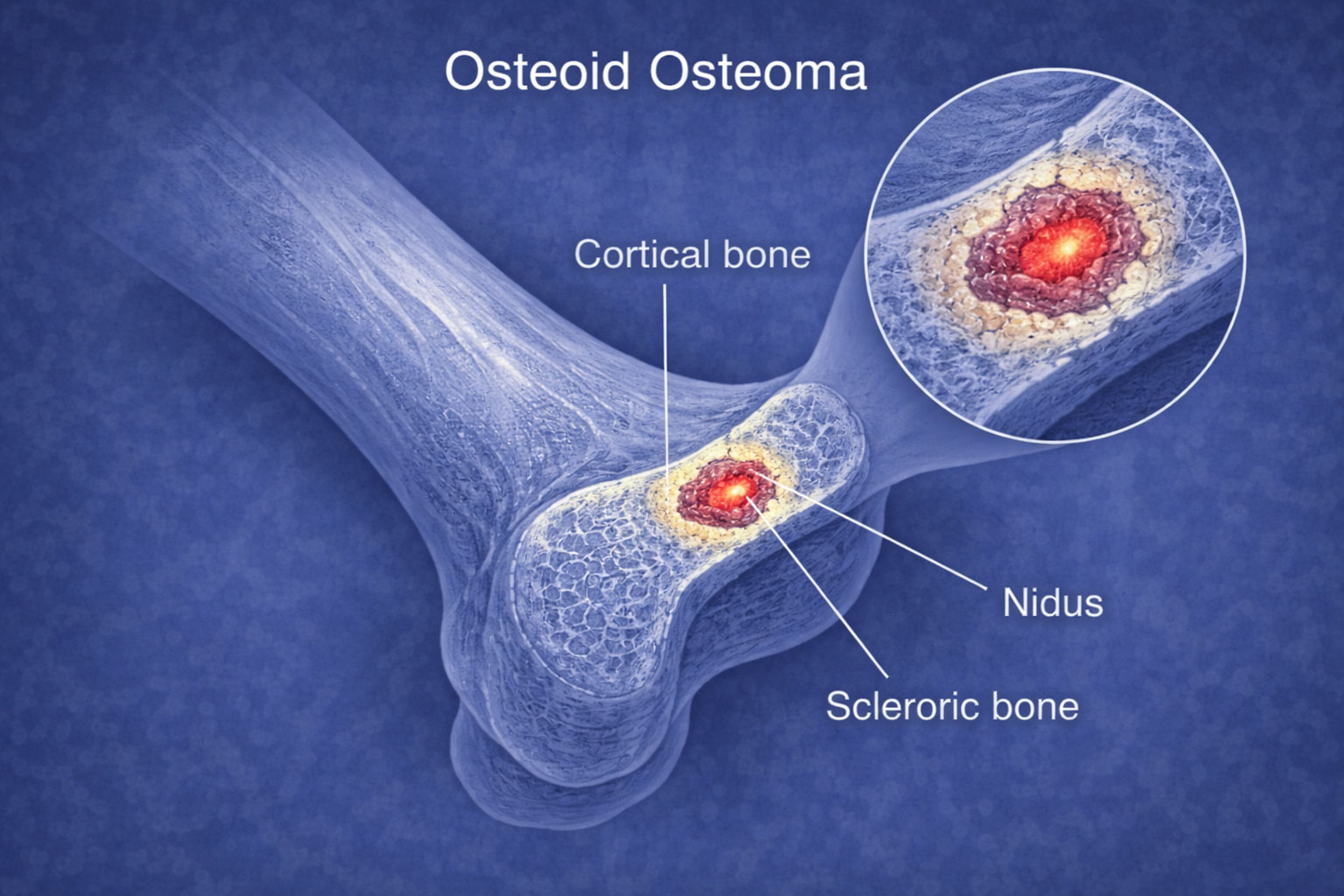
Osteoid osteoma is a small, benign bone tumor that can cause severe pain, especially at night. It commonly affects children, teenagers, and young adults.

Osteoid osteoma ablation is a safe, minimally invasive procedure that destroys the tumor using heat—without open surgery, stitches, or long hospital stay.
👉 Severe bone pain, especially at night?

What Is Osteoid Osteoma Ablation?

Osteoid osteoma ablation is a image-guided treatment in which heat energy (usually radiofrequency or microwave) is used to destroy the tumor (nidus) from inside the bone.

This treatment:

  • Permanently removes the pain-causing tumor
  • Provides rapid pain relief
  • Avoids open bone surgery
  • Allows quick return to normal life
  • No open surgery

  • No scars

  • Day-care procedure

  • Very high success rate

What Is Osteoid Osteoma?

Osteoid osteoma is a non-cancerous bone tumor that usually measures less than 1–1.5 cm.

Common features include:

  • Severe pain, worse at night
  • Pain relief with painkillers (NSAIDs)
  • Limping or restricted movement
  • Commonly affects long bones (femur, tibia), spine, or foot

Although benign, the pain can be debilitating and affect sleep, school, work, and sports.

How Is Osteoid Osteoma Ablation Done?

The procedure is performed by an interventional radiologist under CT scan guidance for pinpoint accuracy.

Step-by-step procedure:

  • You are given local anesthesia and sedation (or general anesthesia in children)
  • A small needle is guided into the tumor using CT scan
  • A special probe is placed into the nidus
  • Heat energy is applied to destroy the tumor
  • The probe is removed and a small dressing is applied

What Are the Risks?

Osteoid osteoma ablation is very safe when performed by experienced specialists.
Possible risks with approximate incidence include:

  • Temporary pain or swelling – common (10–20%)
  • Skin burn near entry site – rare (<2%)
  • Infection – very rare (<1%)
  • Nerve irritation (location-dependent) – very rare (<1%)
  • Incomplete ablation requiring repeat treatment – uncommon (3–5%)

What Are the Alternatives?

Treatment options for osteoid osteoma depend on:

  • Severity of pain (especially night pain)
  • Location of the bone lesion
  • Your age, daily activity level, and overall health
  • Response to medications

Your clinician will help you choose the most appropriate option.

Alternative 1: No Active Treatment (Observation Only)

  • Avoids procedures or surgery
  • Some osteoid osteomas may slowly resolve over several years
  • However:
    • Pain often persists or worsens, especially at night
    • Long-term pain medicines may be required
    • Daily activities and sleep quality can be significantly affected

Alternative 2: Pain Medications (Medical Management)

  • Anti-inflammatory medicines (NSAIDs) can reduce pain
  • Often provide temporary relief, especially in early stages
  • Long-term medication use may lead to:
    • Stomach, kidney, or heart side effects
    • Inadequate pain control over time
  • Does not remove or destroy the tumor, only controls symptoms

Alternative 3: Surgical Removal

  • Involves open surgery to remove the osteoid osteoma
  • Requires bone cutting and removal of surrounding tissue
  • Considered more invasive
  • Has:
    • Higher risk of complications
    • Longer hospital stay and recovery
    • Possibility of bone weakening or fracture
  • Surgeons usually require precise localization of the lesion before surgery

📌 Compared to surgery, ablation is safer, faster, and has quicker recovery with excellent cure rates.

What Happens After Your Procedure?

Recovery is usually fast and smooth.

After ablation:

  • Pain relief often occurs within 24–72 hours
  • Night pain usually disappears completely
  • You can walk the same day or next day
  • Normal activities resume in 2–5 days
  • Sports may be resumed after medical advice
  • Follow-up imaging may be done if required

Most patients experience complete and permanent pain relief.

Frequently Asked Questions (FAQs) – Osteoid Osteoma Ablation

Osteoid osteoma ablation is a minimally invasive treatment that destroys a small benign bone tumor using heat (radiofrequency or microwave energy) under CT guidance, without open surgery.

Yes. Osteoid osteoma ablation has a very high cure rate (over 90–95%), and most patients experience permanent pain relief.

No. Osteoid osteoma is a benign (non-cancerous) bone tumor, but it can cause severe pain if not treated.

The procedure itself is not painful as it is done under anesthesia. Mild soreness after the procedure is temporary and usually settles within a few days.

Most patients notice significant pain relief within 24–72 hours, especially the characteristic night pain.

Patients with:

  • Severe bone pain (often worse at night)
  • CT-confirmed osteoid osteoma
  • Poor quality of life due to pain

Desire to avoid open surgery

Yes. This procedure is commonly and safely performed in children and adolescents, with excellent outcomes.

The procedure usually takes 45–90 minutes, depending on the location of the tumor.

Most patients are discharged the same day or after overnight observation, depending on age and tumor location.

Recurrence is uncommon. If it does occur, repeat ablation can be safely performed.

Risks are minimal and uncommon, such as temporary pain, mild swelling, or very rarely infection or nerve irritation.

In most cases, surgery is not required. Ablation replaces the need for open surgical removal.

Most patients return to normal daily activities within 2–5 days. Sports activities may resume after medical advice.

Yes. It is available in specialized interventional radiology centers across India.

You should seek medical evaluation if:

  • Bone pain is severe or persistent
  • Pain worsens at night
  • Pain improves temporarily with painkillers
  • Pain affects sleep or daily activities

Why Choose Osteoid Osteoma Ablation?

  • One-time curative treatment

  • No open bone surgery

  • Minimal pain and fast recovery

  • Very high success rate

  • Suitable for children and adults

Take the Next Step - End the Pain for Good

If you or your child is suffering from severe bone pain due to osteoid osteoma, you don’t have to live with it.

Osteoid osteoma ablation offers a safe, minimally invasive, and permanent solution.